In Front of a Bowl of Peaches
‘Art does not reproduce the visible but makes visible’ ~ Paul Klee
One late summer afternoon I sat in front of a crystal bowl of peaches slighted tilted by a coin. I had been eager to learn how to paint for a long time and I was both excited and understandably a bit anxious about what was coming. I knew it would not be a ‘typical’ painting class. I was fully aware that my teacher had more in mind than teaching me how to paint. I knew it was about looking, deeply. I knew it was about seeing. I knew it was about sensing. I knew it was about Buber’s I-Thou relationship. It was definitely not about technique not even skill.
I was given watercolors. I don’t like watercolors; I find them uncontrollable. The color diffuses on the paper in a way that is completely unpredictable: I want to put some color here and as the brush touches the paper—oops!—it’s all over. I don’t know the technique. I was not taught any techniques.
 I was told I should not try to draw the overall still life scene with a pencil, but instead start painting directly (I’m not sure why). That’s about all I was told. I was shown a few pictures of Cezanne’s watercolors—his own bowl of fruit. Of course, I know Cezanne’s work was not about representing reality as it is seen. Cezanne is the father of cubism. And modern art goes beyond representing reality; it is about perceiving the essence of reality; it is about the relationship between the artist and the object—an object that is not “it” but “thou.” Modern art is about ‘wholeness’.
I was left alone.
I observed the bowl; I observed the peaches. I still remember them vividly. The crystal bowl had oblong carvings and the light was reflecting on each one with multiple hues of grey—from white to dark grey. Through the bowl I could see blurry shapes—the rounded shapes (although they did not look rounded) of the peaches at the bottom of the bowl. I loved the colors of the peaches—from deep purple to orange to bright yellow. I wanted to capture those colors. I also saw their roundness: how was I going to paint their roundness?
I realized the process was not going to go well at the second I started to add color on the paper. “Ah! Watercolors!” Fairly quickly, I started to feel tension growing in my body. I felt a ball growing in my throat. My eyes became watery. More than anything, I started to feel very angry. I was in terrible emotional and physical pain. Why was I left here alone with no instructions on how to work with watercolors? “Stay calm! Breathe! Look! Try again! It’s about the process. You never painted before. Why would you expect to get any results on the first try? I hate this! Boy! I want to throw all this away! This is useless—meaningless!” Negative thoughts were flowing. I can still feel the emotion in my body by simply recalling the event.
I’m not sure how long I stayed there— 45 minutes to one hour, perhaps. When my teacher came back I had painted the shape of the bowl and a few peaches that did not look like peaches and were as flat as the paper they were on. I was told I had forgotten to capture the overall scene and that it would have been helpful to put objects in relationship with one another. “Darn! I knew that!” But, in my eagerness of try to control the watercolors, I exclusively focused on the peaches and the bowl and completely forgot everything else. My bowl was basically floating up in the air!
I was very angry. I probably complained again about the watercolors. I felt terrible. I hated the whole experience and myself. Perhaps my teacher was disappointed in me because he did not debrief much. He simply brought my attention to a small passage in the watercolour and said it was “excellent.” But I did not hear this and I did not see anything “excellent” in what I had done. We cleaned up and never talked about it anymore.
What was I supposed to learn from this exercise? I’m still struggling with the answer. I was put in a situation of not knowing, of high uncertainties. There was no expert, only someone eager to learn (or so I thought!). In fact, the situation I was in is quite similar to the “adaptive challenges” I am eager to facilitate in my professional life. In this case, however, it was not about ‘midwifing’ a group through the process of change; it was about facilitating my own self through a very experiential learning process. And I failed miserably!
I could have used the exercise as an opportunity to experiment, problem-solve and learn, in a completely safe environment; instead, I tried to control the medium. The less it behaved the way I wanted, the harder I tried. Why I followed the few instructions that were given to me without even questioning them is beyond me today. The trust I hold for my teacher and the desire to please (there must be a reason for doing it like this: do what you were told!) blinded me. I had a pencil. Why didn’t I try to sketch the whole scene to help me start? There were gouaches on the table. Why didn’t I try to use them? And, why didn’t I truly “play” with the process. Perhaps I could have messed up what I had done (knowing it was worthless) and experiment with the watercolors—go abstract! (Yes, but in my mind, I was there to capture what I was looking at.).
While I was inherently free to do whatever pleased me, I voluntarily constrained myself and restricted the realm of learning possibilities. I applied a mechanical mind to a creative process, which should have been fully organic. It was not about techniques and about representation. But, that’s the box I put myself in. And, once in the ‘box,’ the challenge was too daunting because there were too many things I had to learn at once (observing, sensing, creating my composition, learning how to use the medium and experimenting with it, etc.), and I had no experience. I was addressing complexity with a simplistic and reductionist mind: this never works! As a very powerful teacher once said: “If that student wants to escape the mediocrity of management and its education, the student will have to seek the burning fire of authentic learning.” That day in front of a crystal bowl of peaches I was not an authentic learner!
The fact that I realize this today, weeks after the event, is a ‘creative collapse’ with deep transformative power—one that will help me become who I must become: an authentic, creative, and highly adaptive individual able to navigate, and help other navigate, the complexity of today’s world.
Beatrice
Postscript
From my teacher: “In that hour you will see, one day, is almost everything you can possibly do and know — but it is rightly hidden now, and it is for me to sense that, and to rightly withhold, until that day comes.”
I know there is still much I do not understand from this experience. But, I’ll let it go until the day comes and I will see. Meanwhile, I’ll practice humility while remembering that art is about “feeling—not knowing or believing or thinking” and I will keep the advice of the poet e.e. cummings in mind:
“A poet is somebody who feels, and who expresses his feelings through words.
This may sound easy. It isn’t.
[Snip]
If, at the end of your first ten or fifteen years of fighting and working and feeling, you find you’ve written one line of one poem, you’ll be very lucky indeed.”
[Snip]
e.e.cummings, A Poet’s Advice: http://www.mudcat.org/thread.cfm?threadid=61872
Cezanne’s Bowl of Fruit, watercolors, from http://www.paul-cezanne.org
No Problems – No Solutions: Only Complex Emerging Realities
Here is something for you to ponder upon: in today’s complex world, THERE ARE NO PROBLEMS TO SOLVE AND THERE ARE NO SOLUTIONS ABLE TO ‘FIX’ THEM. We are fooling ourselves when we believe otherwise. Robert Fritz makes this really clear:
“We have been trained to think of situations that are inadequate for our aspirations as problems. When we think of them as problems, we try to solve them. When you are solving a problem, you are taking action to have something go away: the problem. When you are creating, you are taking action to have something come into being: the creation.” [1]
Why is it so misleading to focus on solving problems? Let’s remember that how we label things influences the meaning we attach to these things. Words we use and thoughts we think are not neutral: they directly participate in creating our own reality and influence each one of our actions. When we think in terms of ‘problems’ we think in terms of ‘things’ or ‘situations’ that we want to see go away: we see hunger in developing countries and we send foreign aid to get rid of it; we see water and air pollution and we want the manufacturing companies that are at the origin of the problem to address it, promptly. Of course, when we go to the store to buy the products originating from these same manufactures, we don’t really think about the fact that, through our purchasing, we ourselves become an active participant in the pollution issue. We believe the problem is not ours; it’s in someone else’s backyard.
None of our ‘fixes’ eliminate problems. Most often, they mitigate symptoms. At the best, they alleviate pain and misery for a few, a much necessary temporary relief. Perhaps, they make us feel less guilty. Unfortunately, our solutions rarely attempt to address the root causes of problems. Consequently, our fixes create negative long-term side effects and unintended consequences, which are often worse than the symptoms they were meant to address in the first place. (The list of such examples is long: for instance, the desertification of the Sahel region near the Sahara desert was a consequence of the alteration of the local agricultural patterns due to the introduction of development policies to revitalize the area, after the arrival of the French in West Africa in the late 19th century—policies which included digging wells, conducting veterinary and medical campaigns and opening new markets. Counterintuitive? Indeed it is! [2]
Our realities are not static; the specific issues we deal with are, in fact, dynamically evolving situations, which are under the influence of the complex interactions over time of a multitude of individual actions occurring in diverse entangled systems. The structures of these systems have been developed over decades, sometimes centuries, and are grounded in old worldviews deeply embedded within us. We have become blind men, unable to perceive reality as it really is.
The writing of the physicist David Bohm provides a deep source of inspiration and insights for learning how to see reality with fresh eyes. Bohm explains that because thoughts control us, they are at the origin of all that we do:
“…the general tacit assumption in thought is that it’s just telling you the way things are and that it’s not doing anything—that ‘you’ are inside there, deciding what to do with the info. But you don’t decide what to do with the info. Thought runs you. Thought, however, gives false info that you are running it, that you are the one who controls thought. Whereas actually thought is the one which controls each one of us. Thought is creating divisions out of itself and then saying that they are there naturally. This is another major feature of thought: Thought doesn’t know it is doing something and then it struggles against what it is doing. It doesn’t want to know that it is doing it. And thought struggles against the results, trying to avoid those unpleasant results while keeping on with the way of thinking. That is what I call “sustained incoherence.” [3]
For Bohm, thoughts and actions cannot be considered separately: together, they make a whole. Consequently, he urges us to take the time to examine our thoughts so that we can start seeing reality as a whole. When we focus on the whole, we start seeing patterns—thought patterns, intangible patterns and physical patterns. These patterns are a source of deep insights into 1) the nature of our current reality (present); 2) how this reality came into being over time (past); as well as insights or clues on what might be done to improve our current reality (future).
The process of focusing on the past, present, and future, all at once, is highly generative: the pattern development history helps us unfold reality from the past and create new understanding from which one can re-interpret the present. When this happens, the original problems we started with dissolve as we now have the ability to uncover the dynamic and complexity of what is. From this place, creating the future becomes straightforward: we know what must be done and what action to take since our mind is now capable of painting a different reality.
Since the mind constructs its own reality, breaking out from our old ways of seeing is an art; it is a creative process. It is what Pierre Wack, the father of scenario planning at Royal Dutch/Shell, called “The Gentle Art of Reperceiving.” As Wack puts it:
“Decision-scenarios, by being alternative “ways of seeing the world,” are a systematic method for breaking out of this one-eyed view. In a proper sense, such scenarios confer a gift of second sight and can achieve something very precious: the ability to re-perceive reality.” [4]
As change agents and leaders, we have the responsibility to learn how to really see patterns and hidden realities as well as create new realities; we also need to help each other do the same. As Peter Senge argues:
“ Leadership is about creating a domain in which human beings continually deepen their understanding of reality and become more capable of participating in the unfolding of the world. Ultimately, leadership is about creating new realities.” [5]
“Genius, in truth, means little more than the faculty of perceiving in a nonhabitual way.” ~William James
[1] Fritz, Robert (1999). The Path of Least Resistance: Designing Organizations to Succeed. Berrett-Koehler Publishers, Inc.
[2] Brough Wayne T. and Mwangi S. Kimenyi (2004). “Desertification” of the Sahel: Exploring the Role of Property Rights, in Perc Reports, Special Issue: Africa. Vol 22, No 2, June 2004.
[3] Bohm, David (1994). Thought as a System. Routledge, London.
[4] Wack, Pierre (1984). The Gentle Art of Reperceiving. Working paper. Reprinted by Global Business Network by permission.
[5] Jaworski J. and Betty S. Flowers (1996). Introduction to Synchronicity: The Inner Path of Leadership. Introduction by Senge, Peter.
Please Stop!
How often have you been involved in a project and realized that the key driver to keep everyone moving along was the schedule, not the quality of the outcome? Or other times when you intuitively knew that the tools or methods you were using were outdated and not appropriate for the task, that the team lacked creativity and insight, that you were simply re-applying old strategies to address intricate problems—yet, you did not dare to raise your concerns because of the fear of interrupting the momentum or being considered, with no doubt, a “disturber,” someone who does not play by the rules. (Well, perhaps you have raised your concerns a few times with no success, so you let it go.)
In contrast, how often have you been in a situation where participants decided to voluntarily stop the process—not to bring it to an end but to simply take the time to assess the situation and reflect; to evaluate how to take into consideration a new piece of information or an event that just occurred that is changing the current reality; to verify if the team was still focusing on the real vision, the true outcome; or to assess whether the process needed some changes? Rarely, I’m afraid. The reason we don’t like to stop is simple and deeply embedded in our Western business culture: whether or not the schedule is a hard constraint, we always feel the pressure to keep things moving along. Stopping a process creates instability and a sense of urgency—it generates a crisis. By interrupting the flow of our activities we send a message that something is not right; and this is often perceived as a step back because there is no guarantee that, as we lose our momentum, we will know how to move forward again—and this is scary and stressful.
Perhaps we should remember here one of the main principles of Lean Thinking: Stopping the process to build in quality (Jidoka). This concept was very foreign to U.S. automobile manufacturers in the 1970’s. In his book “The Toyota Way” Jeffrey Liker recalls how managers at General Motors “were judged by their ability to deliver the numbers. Get the job done no matter what—and that meant getting the engines to the assembly plant to keep it running.” (Sound familiar?) Stopping the assembly line was something inconceivable for American car manufacturers. Yet, a culture of stopping the process to fix problems and get quality right first time is essential to Lean Thinking.
While the challenges we face in our society today cannot be compared to the problems encountered on an assembly line, I do believe that Lean Thinking, as a holistic approach to management, is very relevant and applicable to how we manage our projects and initiatives and, learning when to stop to reflect and examine our thoughts, is primary.
In “Thought as a System” the physicist David Bohm states that, “until we can stop and look at thought, we can not halt the ongoing introduction of actions which failed to see the whole.” There is no point in running fast if we are running in the wrong direction; if the forces that drive us to run are misguided; or if we are focusing on the trees while forgetting the forest. By stopping the flow of our actions to examine our thoughts and looking deep into their rationale—that is, by defining the mental models that influence our thoughts and actions—one might be able to “see” and perceive our reality with new eyes. And I believe that when we do so, nothing will look the same ever again.
We shall not cease from exploration
And the end of our exploring
Will be to arrive where we started
And know the place for the first time
~T. S. Eliot, Four Quartets – Little Gidding
Liker, Jeffrey K. (2004). The Toyota Way: 14 Management Principles from the World’s Greatest Manufacturer. McGraw-Hill.
Bohm, D. (1992,1994). Thought as a System. London: Routledge.
No, We Won’t Be Done!
We have the tendency, whether it is in the business world, in governments, in society in general, and even in our personal lives, to want to be “done.” Whatever project, initiative or problem we are involved with, we want to get to completion, solve the issue, submit our deliverables and be done. This drive might be well intended and grounded in the implicit need to feel that we have achieved something and made a difference, but the goal to be “done” is often unrealistic, misleading, and at times plainly irresponsible—especially when dealing with complex societal or environmental issues. Being done means that we are drawing boundaries in space and time; it is an illusion. Is Nature ever done?
When we declare that we have solved a problem, one is likely to have only addressed a symptom. The illusion of being done is due to our unwillingness or inability to see unintended consequences—unfortunately often negative—or unexpected changes in the system. (Think for instance of the impact of fish farms, a solution to address wild fish depletion but which is creating huge pollution problems and the need to give antibiotics to the fish so that they can survive in their enclosed environment.)
If we are really serious about improving our state of affairs, we are going to have to take an attitude of humility in admitting our limits and our failures and accept the idea that we won’t be done, that we won’t solve the problem for our children and that no generation will be able to declare “we are done.”
To close this post, here is a quote from Nobel physicist Richard Feynman:
“If we take everything into account, not only what the ancients knew, but all of what we know today that they didn’t know, then I think we must frankly admit that we do not know.
But in admitting this, we have probably found the open channel.
This is not a new idea; this is the idea of the age of reason. This is the philosophy that guided the men who made the democracy that we live under. The idea that no one really knew how to run a government led to the idea that we really should arrange a system by which new ideas could be developed, tried out, tossed out, more new ideas brought in: a trial and error system. This method was a result of the fact that science was already showing itself to be a successful venture at the end of the 18th century. Even then it was clear to socially minded people that the openness of the possibilities was an opportunity, and that doubt and discussion were essential to progress into the unknown. If we want to solve a problem that we have never solved before, we must leave the door to the unknown ajar. …
It is our responsibility to leave the men of the future with a free hand. In the impetuous youth of humanity, we can make grave errors that can stunt our growth for a long time. This we will do if we, so young and ignorant, say we have the answers now, if we suppress all discussion, all criticism, saying, ‘This is it, boys! Man is saved!’ Thus we can doom man for a long time to the chains of authority, confined to the limits of our present imagination. It has been done so many times before.”
Feynman, Richard P. and Leighton, Ralph (1988). What Do You Care What Other People Think?: Further Adventures of a Curious Character. W.W. Norton & Company Inc.
Leadership for Emergence
Note: An expanded version of this post was published as Notes from the Field in Integral Leadership Review (Oct 2010).

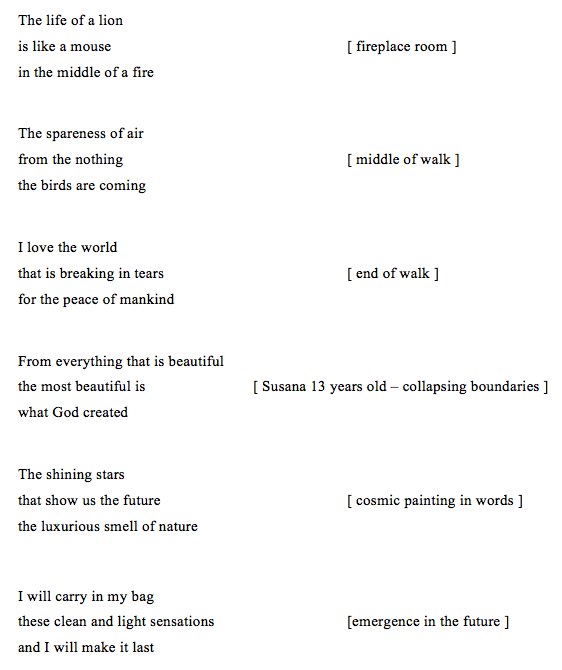
I love the World
that is breaking in tears
for the peace of mankind
My colleague Andrew J. Campbell and I just co-facilitated our new Leadership for Emergence course in South of France and we can still feel the energy. We are excited at the future potential of this unique and in many ways unusual creative offering in the peaceful and inspiring commune of St Jean de Laur, located at the heart of the Quercy.
Imagine yourself going away from your busy professional life to a three-day course. Instead of booking into a hotel or typical retreat ‘facility’ you find yourself in Beatrice’s own family country property. Just renovated, it includes all the modern comforts while keeping its original style and charm and still carrying the rich history of her family over the years.
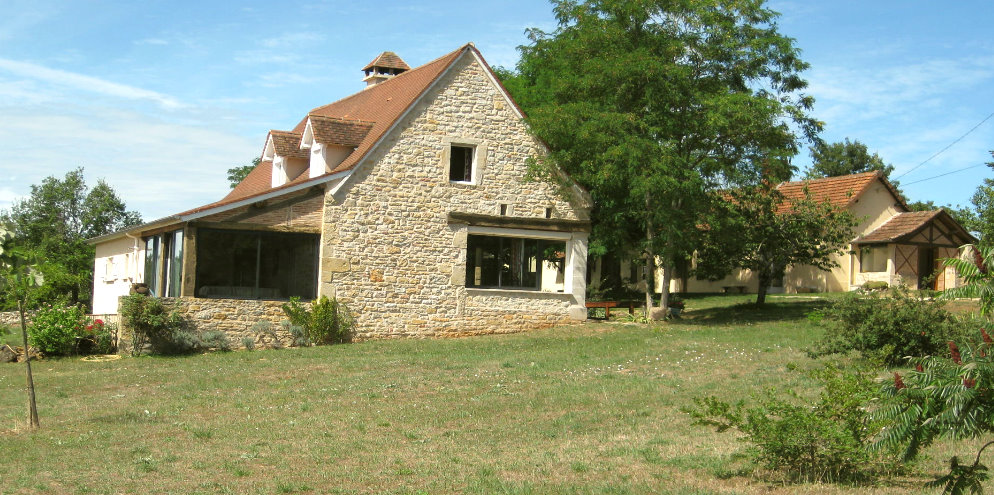
St Jean de Laur Property
Every day, you will share homemade breakfast, lunch and dinner made from fresh local food; you will enjoy walks and hikes on trails lined by centuries old stonewalls and punctuated by shepherds’ stone huts. Now, see yourself at the end of a warm day, swinging gently in a hammock and gazing on the billion stars that are the Milky Way. If you are lucky, you may even see a shooting star.

Stone huts, trails, trees and fields
This unique course deliberately keeps the size of the group to six people in order to provide personal attention and the appropriate level of coaching to each participant based on their specific leadership needs at every given moment. Over three days, Andrew and Beatrice will attend you as you progress through your own creative journey. One important goal we set ourselves is to create an environment that facilitates spontaneous insights as participants open their senses more wholly moving from double-loop learning to achieve triple-loop learning—that is, learning which comes from the heart and that integrates explicit knowledge (knowledge in the mind), tacit knowledge (experience) and transcendental knowledge (wisdom). Central to our living design is the belief, based on our experience, that the inner state dynamically balanced with Nature is key to any transformative journey and that all change process must be grounded in our own authenticity.
With the assistance of Nature, Art and Dialogue, we choose to focus on helping individuals connect with ‘source’ that reawakens natural creativity. Throughout the process we aim at co-generating with participants an unbroken field that reveals their own emergent destination. The heuristic structure allows us to create a very fluid process, reflecting Nature’s creativity, from a set of activities that are adapted to the unfolding need of each of the participants. Our intent is to facilitate participants’ reconnection to the very meaning and new purpose of their lives—as Andrew puts it, “with lightness of touch at the speed of light.”
Since a picture is worth a thousands words, here are a few glimpses and highlights in pictures with some commentaries.
Letting leaves, stones and lichen speak for themselves
“I am powerful, but I don’t know how.”
“I am coming from Nature, going to Nature, but I am outside of it”
“I am fragile, of different forms, yet adaptive.”

Stones, Leaves and Lichens
Painting session
One does not have to be a trained artist to fully engage one’s core creative self. It is sufficient to pick up a brush, open the mind, open the inner eye and paint the vision. Our sole purpose as creative facilitators is to co-create the space for authenticity to reveal itself.
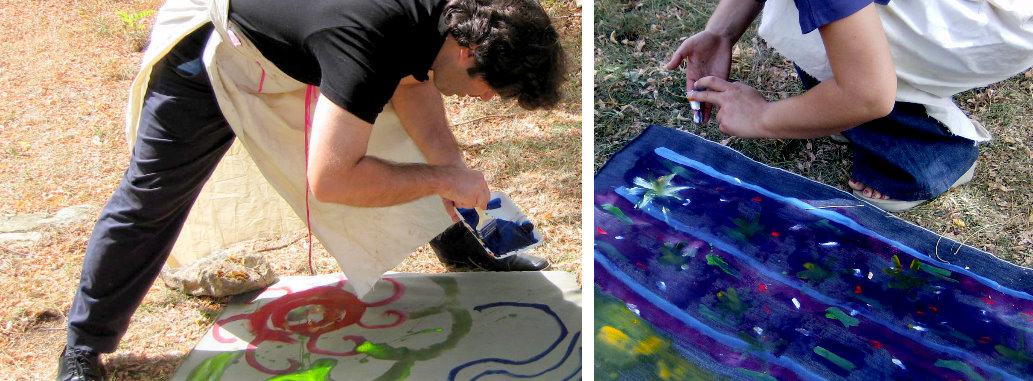
Wisdom of the Hand

The Body Electric and Deep layers of Cosmic Knowledge
The many authentic lessons that may unfold from the connected body-mind in Nature are best captured in what poet William Blake referred to when he wrote “No bird soars too high if he soars with his own wings.” One lesson is that the quintessence of emergence is its irreversibility. It cannot be manufactured; like a dream and like a work of art, it contains past, present and future as one. We can choose to live life as in art, creatively, healed, whole, holy: three words, one reality.
Short Poems
Beatrice and Andrew
Poems and paintings by Augusto and Susana Tomas
Photographs by Andrew J. Campbell


 beatrice benne